Today’s guest post comes from my dear friend, Michelle. I’m honored to have her write about how Cognitive Behavior Therapy (CBT) helped save her from her lowest point, and her triumph over the daily overwhelming thoughts that come with living with type 1 diabetes. The low point for her, came on 9/11/2001, 11 years ago today.
I asked Michelle if she’d be willing to guest post, and I’m thankful she was willing to share, I think you’ll find her writing, raw and honest.
Today’s date is a significant one for many Americans (and for people all around the world). I took a few moments to look at the photographs re-posted on multiple webpages this morning in remembrance of that historic day 11 years ago. The photos capture the powerful moments when people were fleeing in terror from the Twin Towers. In those same moments, service-people and firemen were charging *into* the crumbling buildings, determined to save lives. Wow…talk about a day for gratitude and reflection.
9/11 is also a significant date for me on a personal level. It represents the time in my life when I had reached my lowest point. I had fallen from straight-A, all-star, citizen-of-the-year valedictorian to college drop-out. I didn’t have a place to live, so I was spending my nights in a pop-top VW camper, or on the couches of friends. I was testing my blood sugar once, maybe twice a day. And my average blood sugar was in the 300s. I had been fighting an up-hill battle with depression for some time, and had been on medications galore: Wellbutrin, Phentermine, Topomax, Lexapro, Provigil, Zoloft, Celexa… oftentimes several of those at any given time. And nothing seemed to be working. From the outside, I looked to be having the time of my life. Nights out to Hollywood and TJ were a regular occurrence. I was the social butterfly at events. But, like the Twin Towers, my life was crumbling.
On the morning of 9/11/2001, I woke up to a ringing phone. My face was scratchy from sleeping on the beat-up berber couch in Jay’s apartment. It was Peter calling, telling us to turn on the TV. I did, and for the next few hours we watched in disbelief. My parents have since shared their memories of that morning with me: my mom was taking an early-morning shower. My dad ran into the bathroom, out of breath, saying something about “the world coming to an end.” My dad is usually quite calm and stoic, so this was out of character. My mom recounts her heart dropping to the floor, assuming that surely my dad’s exclamation was related to me being in some kind of trouble.
And it’s likely that if I had continued on the path I was on, trouble certainly would have found me. I had tried normal talking therapy. But it seemed to be breeding more of a victim mentality in my mind. I remember thinking: “Well, great. Hours of sitting on a couch to complain and blame others. But what the heck did I accomplish?” Don’t get me wrong-there’s something cathartic and valuable in the venting process and that type of therapy works well for some. But it wasn’t for me.
What I didn’t realize at that low point in my life was that I needed something different? I needed a deeper understanding of myself and my thoughts. I needed direction and action. And I was lucky enough to find just that…in Cognitive Behavior Therapy (CBT).
CBT saved my life.
Edward Thorndike, Aaron Beck and Albert Ellis are considered the fore-fathers of CBT. The basic idea of CBT is that behind every action and reaction is a thought. And if that thought is based on a cognitive distortion, the resulting action/reaction may go terribly awry. Cognitive distortions generally run deep. They’re engrained in our minds from an early age, and we may not even be aware of them. So it takes WORK to discover and undo them. That’s where CBT comes in. Unlike normal talking therapy (which can go on indefinitely), CBT generally requires just a few sessions with goal-oriented assignments to learn what it’s all about and how it’s done.
A common side-effect of CBT is the surfacing of some uncomfortable feelings. That’s when you know you’re getting somewhere. And dang, it’s worth it! Crippling fears, sadness, anxiety, depression… there’s a reason for those. There’s a thought behind each of them. And there’s something you can do about it.
It’s like diabetes…acquire knowledge and tools and support, and you’ll be able to better keep your blood sugars in check to lead a happy, healthy life. But it’s really up to you. And it’s a life-long endeavor. Usually things go pretty well, but there are days when, no matter how hard you try, your blood sugars go horribly off-track. So, what do you do? Reach out for support, dust off your tools and skills, and get back on the horse! The same is true with CBT (or really any challenge in life). Instead of blood sugars, CBT is about keeping your thoughts in check. It may not be the right tool for everyone, but it’s made a huge difference in my life.
Ultimately, thoughts drive our world. As I learned more, I became fascinated with CBT, the mind, neural plasticity, the power of thought, and the way our brain processes information. That fascination led me back to school to get my BS in Cognitive Science. And it’s led me to where I am today, 11 years after that fateful day. For over a decade, I’ve been completely med-free (other than insulin and thyroid meds…ok, and caffeine!). The beginning signs of diabetes complications from those tumultuous years have disappeared, and I’m rounding the corner to my 26th anniversary with diabetes. Not far behind is my five-year anniversary working at a company I love. I’m celebrating the multiple years of healthy relationships with my parents (for the first time in my life). And I thank my lucky stars every day for some of the best friends and people in my life that a girl could ask for. And then there are the fun times and adventures that I wouldn’t trade for the world. There have been ups and downs, of course. And there are more to come. But with the CBT arrows in my quiver, I’m ready. I’m excited for today, and more excited for tomorrow.
And the next time I find myself sleeping on a friend’s couch or in a van, it will be because of some fun adventure, or just because I want to be able to say “I live in a van down by the river!”
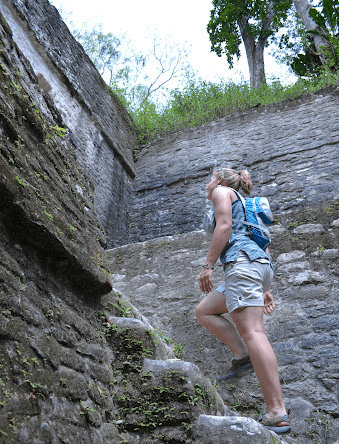
Climbing out of a low point in life to climbing out of a Mayan Ruin in Belize











 livinglikelinds